
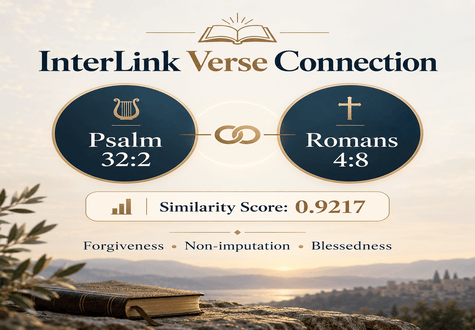
The verse connection of the week shows the closest semantic neighbor to our target verse. We briefly explain the metric from a scientific standpoint and provide a short theological background to show how they might be connected.
Anchor Text: Psalms 32:2, KJV 1769
“Blessed is the man unto whom the LORD imputeth not iniquity, and in whose spirit there is no guile.”
Top Semantic Neighbor: Romans 4:8, KJV 1769
“Blessed is the man to whom the Lord will not impute sin.”
InterLink Similarity Score: 0.9217
Explanation of metric:
Cosine similarity measures how close two passages are in embedding space. In other words, the closer the score is to 1.0 the more strongly the model sees the passages as related in meaning. This does not prove the passages mean the exact same thing, but helps to identify passages worth comparing more closely.
Why these passages are similar:
Both passages highlight the blessedness of the individual whose sins are not imputed by The Lord. InterLink shows this connection computationally, while the theological context explains why the connection matters.
Contextual Note:
This connection is deeply meaningful because Romans 4 directly uses the language of Psalms 32 to discuss forgiveness and the blessedness of the person whose sin is not counted against them. Together, these passages speak on themes of forgiveness, iniquity, inward sincerity, righteousness, and divine mercy. This can be further explained by Romans 4:5-7 which explains that faith, apart from works or deeds, is credited as righteousness. This connection paints a scene of a sincere person who despite having committed sins is not imputed them by The Lord and granted righteousness through their faith without the necessity of works.
Further Research and Reflection:
– How and why does the Lord not impute sin to the person described in these passages?
– What specifically is this faith in?
– Why is a person considered blessed when their iniquity is not imputed to them?
Disclaimer:
InterLink helps surface meaningful textual relationships that can then be examined through historical, theological, and literary context. It does not replace interpretation. This is an exploratory result using the current InterLink semantic search layer.
Be well.
Leave a Reply