
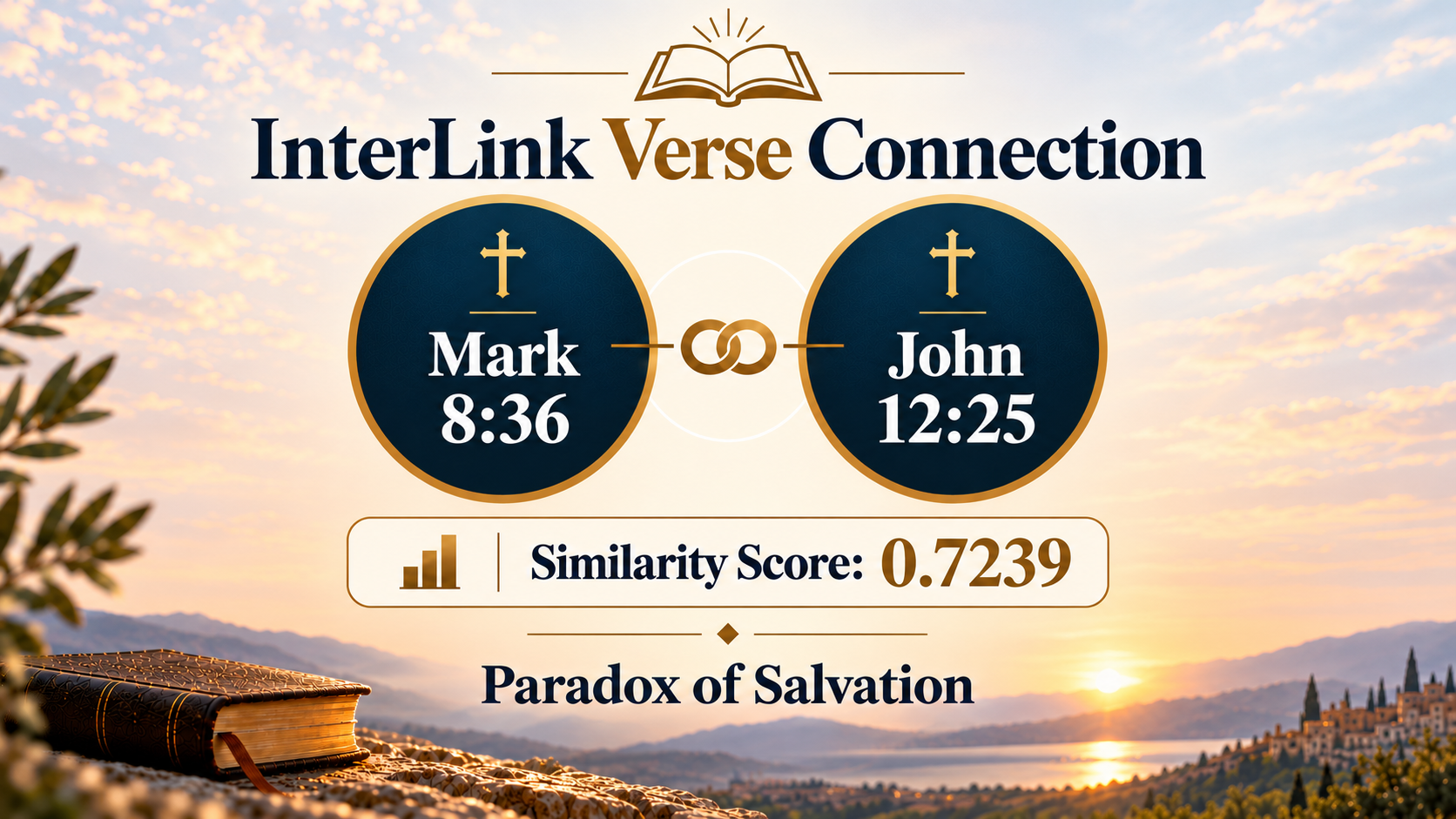
The verse connection of the week shows the closest semantic neighbor to our target verse. We briefly explain the metric from a scientific standpoint and provide a short theological background to show how they might be connected.
𝗔𝗻𝗰𝗵𝗼𝗿 𝗧𝗲𝘅𝘁: Mark 8:36, KJV 1769
“For what shall it profit a man, if he shall gain the whole world, and lose his own soul?”
𝗧𝗼𝗽 𝗦𝗲𝗺𝗮𝗻𝘁𝗶𝗰 𝗡𝗲𝗶𝗴𝗵𝗯𝗼𝗿: John 12:25, KJV 1769
“He that loveth his life shall lose it; and he that hateth his life in this world shall keep it unto life eternal.”
𝗜𝗻𝘁𝗲𝗿𝗟𝗶𝗻𝗸 𝗦𝗶𝗺𝗶𝗹𝗮𝗿𝗶𝘁𝘆 𝗦𝗰𝗼𝗿𝗲: 0.7239
𝗘𝘅𝗽𝗹𝗮𝗻𝗮𝘁𝗶𝗼𝗻 𝗼𝗳 𝗺𝗲𝘁𝗿𝗶𝗰:
Cosine similarity measures how close two passages are in embedding space. In plain English, the closer the score is to 1.0, the more strongly the model sees the passages as related in meaning. Current score thresholds are as follows:
- 𝟬.𝟳𝟱 𝘁𝗼 𝟭.𝟬𝟬: Semantic equivalents, or variations of the same passage
- 𝟬.𝟱𝟱 𝘁𝗼 𝟬.𝟳𝟰: Context is highly relevant but uses different language
- 𝟬.𝟰𝟬 𝘁𝗼 𝟬.𝟱𝟰: Shared broad concepts or domains overlap
- 𝗕𝗲𝗹𝗼𝘄 𝟬.𝟰𝟬: Low or no relation
𝗪𝗵𝘆 𝘁𝗵𝗲𝘀𝗲 𝗽𝗮𝘀𝘀𝗮𝗴𝗲𝘀 𝗮𝗿𝗲 𝘀𝗶𝗺𝗶𝗹𝗮𝗿:
Both passages surface the paradoxical tension between salvation and preservation.
𝗖𝗼𝗻𝘁𝗲𝘅𝘁𝘂𝗮𝗹 𝗡𝗼𝘁𝗲:
Self-preservation is an innate, biological instinct to avoid injury and maximize survival. This fundamental tendency is tied to the paradox of salvation because the human instinct to secure and preserve one’s temporal life or material gain inherently results in its absolute destruction, as warned in both Mark 8:36 and John 12:25. Both passages frame salvation as a radical divestment of temporal security, instead of an accumulation of assets, which goes against the very nature of self-preservation. John 12:25 moves further to explain the necessity of this tension, establishing that disregarding one’s earthly life is imperative to inheriting eternal life.
Additional scripture can help clarify this contradiction. James 4:14 establishes the brevity of earthly existence, illustrating that human life is merely a vapor for a little time and then vanishes. Mark 8:36 builds upon this reality, putting into perspective that the defensive preservation of such a fleeting existence is a misallocation of ultimate concern. Ecclesiastes 5:10 reinforces the vanity of this pursuit, showing that even if a person chooses to love gain, and successfully obtains it, they’ll never be satisfied with its abundance.
While John 12:25 speaks on how detesting your earthly life allows you to keep it eternally, its underlying connection to the “gaining of the world” in Mark 8:36 is illuminated by 1 John 2:15-17. The passage commands to “Love not the world, neither the things that are in the world.” because everything within it is not of the Father. And crucially notes that “the world passeth away”, identifying the temporal realm as a dying ecosystem, but those that do the will of God will abide forever.
Attempting to love, hoard, or defensively preserve one’s life within a dying system means an individual will inevitably pass away with it. This is why John 12:25 states you must “hate” your temporal life to inherit an eternal one; it is not a call for a self-loathing hate, but rather a deliberate emotional and spiritual detachment from the temporal world in order to prioritize the eternal will of God. While self-preservation remains a necessary biological instinct for operating in this realm, the economy of salvation dictates that seeking the will of God must be placed entirely above it.
𝗙𝘂𝗿𝘁𝗵𝗲𝗿 𝗥𝗲𝘀𝗲𝗮𝗿𝗰𝗵 𝗮𝗻𝗱 𝗥𝗲𝗳𝗹𝗲𝗰𝘁𝗶𝗼𝗻:
- How does one moderate the tendency of self-preservation?
- What does eternal life mean? How does this connect to the everlasting life mentioned in John 3:16?
- What does it mean to lose your soul?
𝗧𝗮𝗸𝗲𝗮𝘄𝗮𝘆:
The semantic layer uncovered a complex, yet valid thematic link between the anchor verse and its closest neighbor. The human instinct to preserve life in a dying world guarantees spiritual destruction; true preservation means seeking God’s will.
𝗗𝗶𝘀𝗰𝗹𝗮𝗶𝗺𝗲𝗿:
𝘐𝘯𝘵𝘦𝘳𝘓𝘪𝘯𝘬 𝘩𝘦𝘭𝘱𝘴 𝘴𝘶𝘳𝘧𝘢𝘤𝘦 𝘮𝘦𝘢𝘯𝘪𝘯𝘨𝘧𝘶𝘭 𝘵𝘦𝘹𝘵𝘶𝘢𝘭 𝘳𝘦𝘭𝘢𝘵𝘪𝘰𝘯𝘴𝘩𝘪𝘱𝘴 𝘵𝘩𝘢𝘵 𝘤𝘢𝘯 𝘵𝘩𝘦𝘯 𝘣𝘦 𝘦𝘹𝘢𝘮𝘪𝘯𝘦𝘥 𝘵𝘩𝘳𝘰𝘶𝘨𝘩 𝘩𝘪𝘴𝘵𝘰𝘳𝘪𝘤𝘢𝘭, 𝘵𝘩𝘦𝘰𝘭𝘰𝘨𝘪𝘤𝘢𝘭, 𝘢𝘯𝘥 𝘭𝘪𝘵𝘦𝘳𝘢𝘳𝘺 𝘤𝘰𝘯𝘵𝘦𝘹𝘵. 𝘐𝘵 𝘥𝘰𝘦𝘴 𝘯𝘰𝘵 𝘳𝘦𝘱𝘭𝘢𝘤𝘦 𝘪𝘯𝘵𝘦𝘳𝘱𝘳𝘦𝘵𝘢𝘵𝘪𝘰𝘯. 𝘛𝘩𝘪𝘴 𝘪𝘴 𝘢𝘯 𝘦𝘹𝘱𝘭𝘰𝘳𝘢𝘵𝘰𝘳𝘺 𝘳𝘦𝘴𝘶𝘭𝘵 𝘶𝘴𝘪𝘯𝘨 𝘵𝘩𝘦 𝘤𝘶𝘳𝘳𝘦𝘯𝘵 𝘐𝘯𝘵𝘦𝘳𝘓𝘪𝘯𝘬 𝘴𝘦𝘮𝘢𝘯𝘵𝘪𝘤 𝘴𝘦𝘢𝘳𝘤𝘩 𝘭𝘢𝘺𝘦𝘳.
Be well.
𝗜𝗻𝘁𝗲𝗿𝗲𝘀𝘁𝗲𝗱 𝗶𝗻 𝘁𝗵𝗲 𝗿𝗲𝘀𝗲𝗮𝗿𝗰𝗵 𝗯𝗲𝗵𝗶𝗻𝗱 𝗜𝗻𝘁𝗲𝗿𝗟𝗶𝗻𝗸?
These Verse Connection explorations build on the foundation established in my published study, Semantic Stability in the King James Bible: Comparing the 1611 and 1769 Editions. This research continues to evolve, with a follow-up publication in development.
I welcome your thoughts, questions, and interpretations. Whether your interests are in biblical studies, theology, linguistics, or computational research, I encourage you to explore the findings, join the discussion, and connect with me. Your perspectives may help inspire new questions and directions for future research.
𝗥𝗲𝗮𝗱 𝘁𝗵𝗲 𝘀𝘁𝘂𝗱𝘆: Article Link
Leave a Reply